
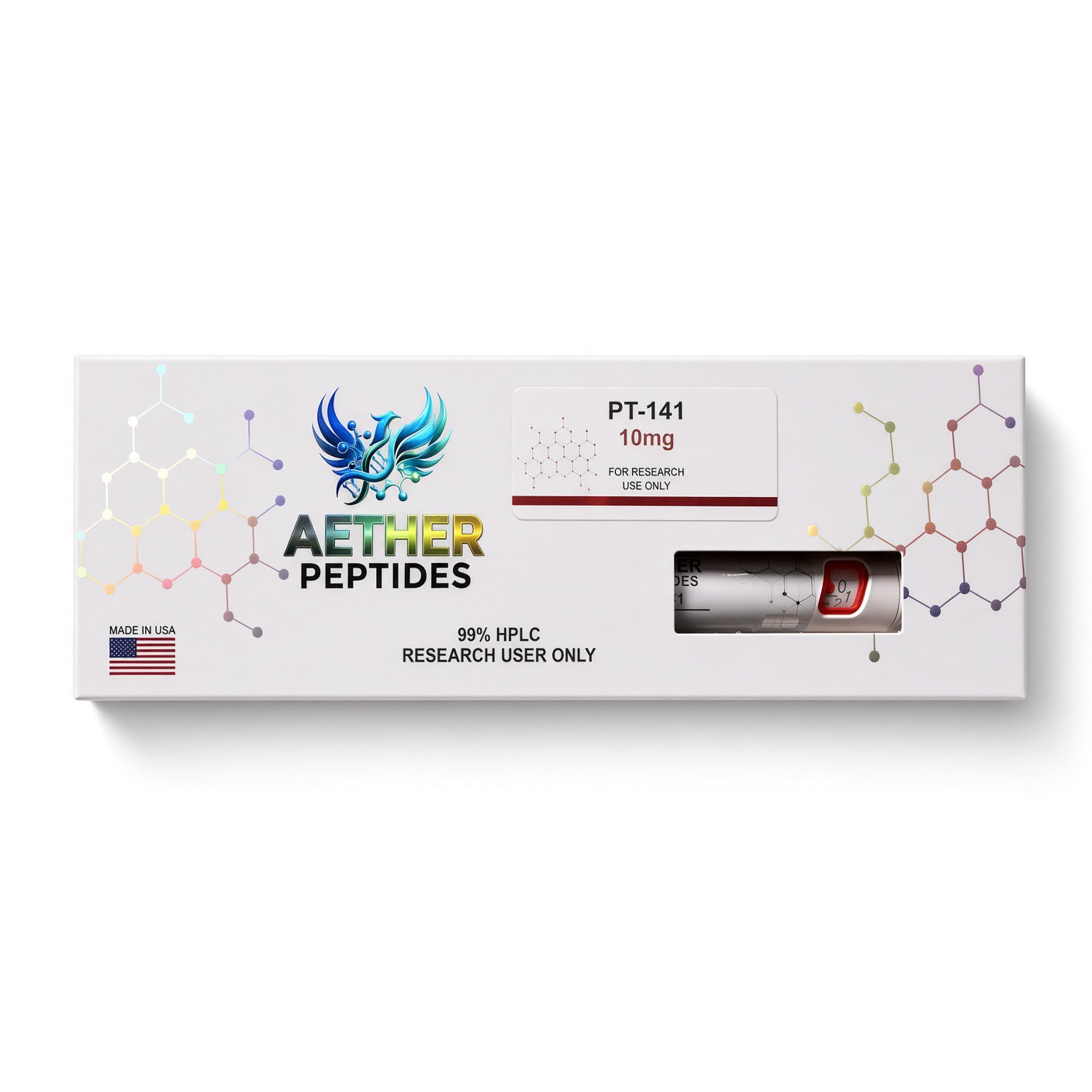
PT-141 10mg

PT-141 10mg

PT-141 (Bremelanotide) — Research Peptide

PT-141 (Bremelanotide) is a synthetic cyclic heptapeptide belonging to the melanocortin-receptor agonist class. It is composed of the sequence Ac-Nle-Asp-His-D-Phe-Arg-Trp-Lys and has a molecular formula of C₅₀H₆₈N₁₄O₁₀ and molecular weight of approximately 1025.2 g/mol for the free-base form. Its CAS number is 189691-06-3.

PT-141 has been extensively studied for its interaction with melanocortin receptors, particularly MC3R and MC4R, and for its role in central neural pathways associated with sexual-response signaling. Unlike PDE5 inhibitors, PT-141 acts through the melanocortin system rather than directly producing vasodilation through the nitric-oxide/cGMP pathway.

Bremelanotide is also the active pharmaceutical ingredient in Vyleesi, an FDA-approved medicine for acquired, generalized hypoactive sexual desire disorder in certain premenopausal women.

Research specifications: PT-141 / Bremelanotide | CAS 189691-06-3 | Molecular Weight 1025.2 g/mol | Molecular Formula C₅₀H₆₈N₁₄O₁₀ | Sequence: Ac-Nle-Asp-His-D-Phe-Arg-Trp-Lys.

For laboratory research use only. Not intended for human or veterinary use, diagnosis, treatment, or consumption.

Research of PT-141

PT-141 (Bremelanotide) is a synthetic cyclic heptapeptide derived from the melanocortin-peptide research program. It is designed to interact with melanocortin receptors in the central nervous system and has been investigated primarily in relation to sexual-function signaling. Unlike PDE5 inhibitors, which primarily affect the vascular response involved in penile erection, bremelanotide acts through the melanocortin system, making it pharmacologically distinct from drugs such as sildenafil. Bremelanotide subsequently became an approved pharmaceutical product. In the United States, Vyleesi (bremelanotide) is indicated for acquired, generalized hypoactive sexual desire disorder (HSDD) in premenopausal women, when the condition causes clinically significant distress and is not attributable to another medical/psychiatric condition, relationship problems, or medication/drug effects. It is not indicated for men, postmenopausal women, or enhancement of sexual performance.

Structure of PT-141

PT-141 (Bremelanotide) is a synthetic cyclic heptapeptide derived from the melanocortin-peptide research program. It is designed to interact with melanocortin receptors in the central nervous system and has been investigated primarily in relation to sexual-function signaling. Unlike PDE5 inhibitors, which primarily affect the vascular response involved in penile erection, bremelanotide acts through the melanocortin system, making it pharmacologically distinct from drugs such as sildenafil. Bremelanotide subsequently became an approved pharmaceutical product. In the United States, Vyleesi (bremelanotide) is indicated for acquired, generalized hypoactive sexual desire disorder (HSDD) in premenopausal women, when the condition causes clinically significant distress and is not attributable to another medical/psychiatric condition, relationship problems, or medication/drug effects. It is not indicated for men, postmenopausal women, or enhancement of sexual performance.

Mechanism and Action of PT-141

he principal pharmacological mechanism of PT-141 is melanocortin-receptor agonism. Melanocortin receptors Bremelanotide is an agonist at melanocortin receptors, with activity particularly associated with MC3R and MC4R. Activation of these receptors can influence neural pathways involved in sexual motivation and sexual-response signaling. PT-141 → melanocortin receptors → central nervous-system signaling → sexual-response pathways

PT-141 and Obesity

PT-141 and Cardiac Disease

PT-141 and Joints

Disclaimer: The products mentioned are not intended for human or animal consumption. Research chemicals are intended solely for laboratory experimentation and/or in-vitro testing. Bodily introduction of any sort is strictly prohibited by law. All purchases are limited to licensed researchers and/or qualified professionals. All information shared in this article is for educational purposes only.

References

  1. Ng, F. M., Sun, J., Sharma, L., Libinaka, R., Jiang, W. J., & Gianello, R. (2000). Metabolic studies of a synthetic lipolytic domain (AOD 9604) of human growth hormone. Hormone research, 53(6), 274–278. https://doi.org/10.1159/000053183
  2. Cox, H. D., Smeal, S. J., Hughes, C. M., Cox, J. E., & Eichner, D. (2015). Detection and in vitro metabolism of AOD 9604. Drug testing and analysis, 7(1), 31–38. https://doi.org/10.1002/dta.1715
  3. Ng, F. M., Jiang, W. J., Gianello, R., Pitt, S., & Roupas, P. (2000). Molecular and cellular actions of a structural domain of human growth hormone (AOD9401) on lipid metabolism in Zucker fatty rats. Journal of molecular endocrinology, 25(3), 287-298.
  4. Heffernan, M. A., Thorburn, A. W., Fam, B., Summers, R., Conway-Campbell, B., Waters, M. J., & Ng, F. M. (2001). Increase of fat oxidation and weight loss in obese mice caused by chronic treatment with human growth hormone or a modified C-terminal fragment. International journal of obesity and related metabolic disorders : journal of the International Association for the Study of Obesity, 25(10), 1442–1449. https://doi.org/10.1038/sj.ijo.0801740
  5. Ng, F. M., Sun, J., Sharma, L., Libinaka, R., Jiang, W. J., & Gianello, R. (2000). Metabolic studies of a synthetic lipolytic domain (AOD9604) of human growth hormone. Hormone research, 53(6), 274–278. https://doi.org/10.1159/000053183
  6. Kopchick, J. J., Berryman, D. E., Puri, V., Lee, K. Y., & Jorgensen, J. O. (2020). The effects of growth hormone on adipose tissue: old observations, new mechanisms. Nature Reviews Endocrinology, 16(3), 135-146.
  7. Heffernan, M., Summers, R. J., Thorburn, A., Ogru, E., Gianello, R., Jiang, W. J., & Ng, F. M. (2001). The Effects of Human GH and Its Lipolytic Fragment (AOD9604) on Lipid Metabolism Following Chronic Treatment in Obese Mice andβ 3-AR Knock-Out Mice. Endocrinology, 142(12), 5182-5189.
  8. Bray, G. A., & Greenway, F. L. (2007). Pharmacological treatment of the overweight patient. Pharmacological reviews, 59(2), 151–184. https://doi.org/10.1124/pr.59.2.2
  9. Heffernan, M., Summers, R. J., Thorburn, A., Ogru, E., Gianello, R., Jiang, W. J., & Ng, F. M. (2001). The effects of human GH and its lipolytic fragment (AOD 9604) on lipid metabolism following chronic treatment in obese mice and beta(3)-AR knock-out mice. Endocrinology, 142(12), 5182–5189. https://doi.org/10.1210/endo.142.12.8522
  10. Kwon, D. R., & Park, G. Y. (2015). Effect of Intra-articular Injection of AOD 9604 with or without Hyaluronic Acid in Rabbit Osteoarthritis Model. Annals of clinical and laboratory science, 45(4), 426–432.