
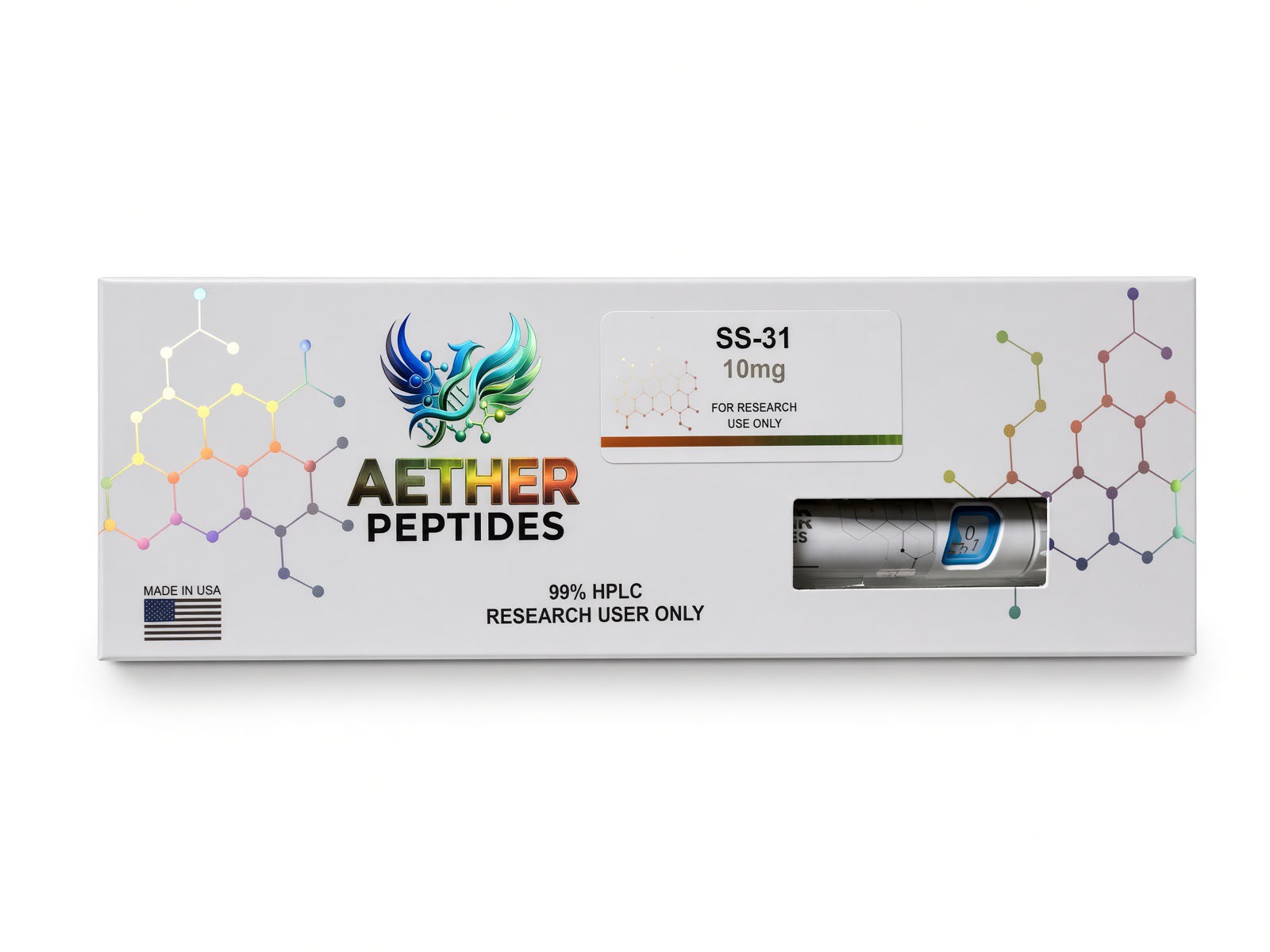
SS-31 10mg

SS-31 10mg

SS-31 (Elamipretide), 10 mg is a synthetic mitochondria-targeted tetrapeptide composed of D-Arg-Dmt-Lys-Phe-NH₂. It selectively associates with cardiolipin in the inner mitochondrial membrane and has been investigated for effects on mitochondrial membrane integrity, respiratory-chain function, ATP production, oxidative stress and apoptosis. Research applications include mitochondrial dysfunction, cardiac bioenergetics, metabolic dysfunction and experimental cartilage injury. Elamipretide received FDA accelerated approval in 2025 as Forzinity for improving muscle strength in patients with Barth syndrome weighing at least 30 kg; its use for obesity, general cardiovascular disease or osteoarthritis remains investigational. Research-use note:  A 10-mg research vial should not be presented as an approved treatment for obesity, cardiac disease, joint disease, or general anti-aging purposes. The regulatory status and evidence differ substantially by indication.

Research of SS-31

SS-31 (Elamipretide) is a synthetic, mitochondria-targeted tetrapeptide developed to interact selectively with cardiolipin, a phospholipid located predominantly in the inner mitochondrial membrane. The peptide contains the unusual amino-acid residue 2,6-dimethyltyrosine (Dmt) and D-arginine, giving it an aromatic-cationic character that facilitates mitochondrial localization. Once associated with the inner mitochondrial membrane, SS-31 interacts with cardiolipin and can influence mitochondrial membrane organization, respiratory-chain activity, ATP generation and oxidative stress. esearch has investigated SS-31 in mitochondrial disorders, cardiovascular disease, metabolic dysfunction, skeletal-muscle disorders and experimental cartilage injury. The strongest current regulatory evidence is in Barth syndrome: the U.S. FDA granted accelerated approval to elamipretide (Forzinity) on September 19, 2025, to improve muscle strength in adults and pediatric patients weighing at least 30 kg with Barth syndrome.

Structure of SS-31

SS-31 (Elamipretide) is a synthetic, mitochondria-targeted tetrapeptide developed to interact selectively with cardiolipin, a phospholipid located predominantly in the inner mitochondrial membrane. The peptide contains the unusual amino-acid residue 2,6-dimethyltyrosine (Dmt) and D-arginine, giving it an aromatic-cationic character that facilitates mitochondrial localization. Once associated with the inner mitochondrial membrane, SS-31 interacts with cardiolipin and can influence mitochondrial membrane organization, respiratory-chain activity, ATP generation and oxidative stress. esearch has investigated SS-31 in mitochondrial disorders, cardiovascular disease, metabolic dysfunction, skeletal-muscle disorders and experimental cartilage injury. The strongest current regulatory evidence is in Barth syndrome: the U.S. FDA granted accelerated approval to elamipretide (Forzinity) on September 19, 2025, to improve muscle strength in adults and pediatric patients weighing at least 30 kg with Barth syndrome.

Mechanism and Action of SS-31

he principal proposed mechanism can be summarized as: SS-31 → mitochondria → cardiolipin → mitochondrial membrane/cristae stabilization → improved respiratory-chain function → improved bioenergetics + reduced oxidative stress A. Mitochondrial targeting SS-31 is an aromatic-cationic peptide that readily enters cells and concentrates in mitochondria. B. Cardiolipin binding Its major molecular interaction is with cardiolipin, which is highly enriched in the inner mitochondrial membrane. Cardiolipin contributes to the architecture of mitochondrial cristae and supports organization of respiratory-chain complexes. SS-31’s interaction with cardiolipin is therefore central to its proposed mitochondrial effects. C. Respiratory-chain function Experimental work indicates that elamipretide can improve aspects of mitochondrial electron transport and respiratory supercomplex function, particularly when mitochondria are dysfunctional. In ex-vivo experiments using failing human hearts, elamipretide improved impaired mitochondrial function and mitochondrial supercomplex activity. D. ATP production By improving mitochondrial coupling and respiratory-chain efficiency, SS-31 has been investigated for its ability to restore or increase mitochondrial ATP production in dysfunctional cells. E. Oxidative stress Cardiolipin oxidation can disrupt mitochondrial structure and function. SS-31 has been reported to reduce pathological mitochondrial reactive oxygen species and cardiolipin oxidation in experimental systems. F. Apoptosis Mitochondrial dysfunction can trigger cytochrome-c release and downstream apoptosis. Experimental work suggests that cardiolipin-targeted protection with SS-31 can reduce mitochondrial damage and cell death.

SS-31 and Obesity

There is a scientifically plausible relationship between SS-31 and obesity-related metabolic dysfunction because obesity and insulin resistance can be accompanied by mitochondrial dysfunction. Preclinical research has specifically investigated elamipretide in models of obesity-induced insulin resistance, pancreatic β-cell injury and metabolic dysfunction. Experimental literature describes effects involving mitochondrial ATP production, oxidative stress and mitochondrial quality-control pathways.

SS-31 and Cardiac Disease

his is one of the most important research areas for SS-31. The heart has exceptionally high mitochondrial energy requirements. Consequently, mitochondrial dysfunction can contribute to impaired cardiac energetics, oxidative stress and myocardial injury. Heart failure Research using failing human cardiac tissue found that elamipretide improved impaired mitochondrial function and mitochondrial respiratory-supercomplex activity. Ischemia/reperfusion Experimental studies have investigated SS-31 for protection against myocardial ischemia/reperfusion injury, with proposed effects involving preservation of mitochondrial function and reduction of oxidative injury. arth syndrome Barth syndrome is particularly relevant because it involves abnormalities in mitochondrial cardiolipin metabolism. Elamipretide’s cardiolipin-binding mechanism provides a direct mechanistic connection. As of 2025, this is no longer solely an experimental concept: the FDA approved Forzinity (elamipretide) under accelerated approval for improving muscle strength in patients with Barth syndrome weighing at least 30 kg. Important: This approval does not mean SS-31 is approved for general heart failure, coronary artery disease, cardiomyopathy or cardiovascular prevention.

SS-31 and Joints

here is a particularly interesting preclinical connection between SS-31 and cartilage. Mitochondrial dysfunction and oxidative stress can contribute to chondrocyte injury following cartilage trauma. Researchers therefore investigated whether cardiolipin-targeted mitochondrial protection could prevent cartilage degeneration. In an ex-vivo bovine cartilage model of post-traumatic osteoarthritis, SS-31 treatment after mechanical impact injury: preserved chondrocyte viability; reduced chondrocyte apoptosis; reduced cell-membrane damage; and reduced cartilage-matrix degeneration. The study also demonstrated that SS-31 could distribute through cartilage and localize to chondrocyte mitochondria. his provides a mechanistic rationale for studying SS-31 in joint disease, but the evidence is preclinical. It should not be represented as an established treatment for human osteoarthritis. A review of the osteoarthritis drug-development field likewise describes SS-31 as a potential mitoprotective strategy rather than an established OA therapy

Disclaimer: The products mentioned are not intended for human or animal consumption. Research chemicals are intended solely for laboratory experimentation and/or in-vitro testing. Bodily introduction of any sort is strictly prohibited by law. All purchases are limited to licensed researchers and/or qualified professionals. All information shared in this article is for educational purposes only.

References

  1. Ng, F. M., Sun, J., Sharma, L., Libinaka, R., Jiang, W. J., & Gianello, R. (2000). Metabolic studies of a synthetic lipolytic domain (AOD 9604) of human growth hormone. Hormone research, 53(6), 274–278. https://doi.org/10.1159/000053183
  2. Cox, H. D., Smeal, S. J., Hughes, C. M., Cox, J. E., & Eichner, D. (2015). Detection and in vitro metabolism of AOD 9604. Drug testing and analysis, 7(1), 31–38. https://doi.org/10.1002/dta.1715
  3. Ng, F. M., Jiang, W. J., Gianello, R., Pitt, S., & Roupas, P. (2000). Molecular and cellular actions of a structural domain of human growth hormone (AOD9401) on lipid metabolism in Zucker fatty rats. Journal of molecular endocrinology, 25(3), 287-298.
  4. Heffernan, M. A., Thorburn, A. W., Fam, B., Summers, R., Conway-Campbell, B., Waters, M. J., & Ng, F. M. (2001). Increase of fat oxidation and weight loss in obese mice caused by chronic treatment with human growth hormone or a modified C-terminal fragment. International journal of obesity and related metabolic disorders : journal of the International Association for the Study of Obesity, 25(10), 1442–1449. https://doi.org/10.1038/sj.ijo.0801740
  5. Ng, F. M., Sun, J., Sharma, L., Libinaka, R., Jiang, W. J., & Gianello, R. (2000). Metabolic studies of a synthetic lipolytic domain (AOD9604) of human growth hormone. Hormone research, 53(6), 274–278. https://doi.org/10.1159/000053183
  6. Kopchick, J. J., Berryman, D. E., Puri, V., Lee, K. Y., & Jorgensen, J. O. (2020). The effects of growth hormone on adipose tissue: old observations, new mechanisms. Nature Reviews Endocrinology, 16(3), 135-146.
  7. Heffernan, M., Summers, R. J., Thorburn, A., Ogru, E., Gianello, R., Jiang, W. J., & Ng, F. M. (2001). The Effects of Human GH and Its Lipolytic Fragment (AOD9604) on Lipid Metabolism Following Chronic Treatment in Obese Mice andβ 3-AR Knock-Out Mice. Endocrinology, 142(12), 5182-5189.
  8. Bray, G. A., & Greenway, F. L. (2007). Pharmacological treatment of the overweight patient. Pharmacological reviews, 59(2), 151–184. https://doi.org/10.1124/pr.59.2.2
  9. Heffernan, M., Summers, R. J., Thorburn, A., Ogru, E., Gianello, R., Jiang, W. J., & Ng, F. M. (2001). The effects of human GH and its lipolytic fragment (AOD 9604) on lipid metabolism following chronic treatment in obese mice and beta(3)-AR knock-out mice. Endocrinology, 142(12), 5182–5189. https://doi.org/10.1210/endo.142.12.8522
  10. Kwon, D. R., & Park, G. Y. (2015). Effect of Intra-articular Injection of AOD 9604 with or without Hyaluronic Acid in Rabbit Osteoarthritis Model. Annals of clinical and laboratory science, 45(4), 426–432.