
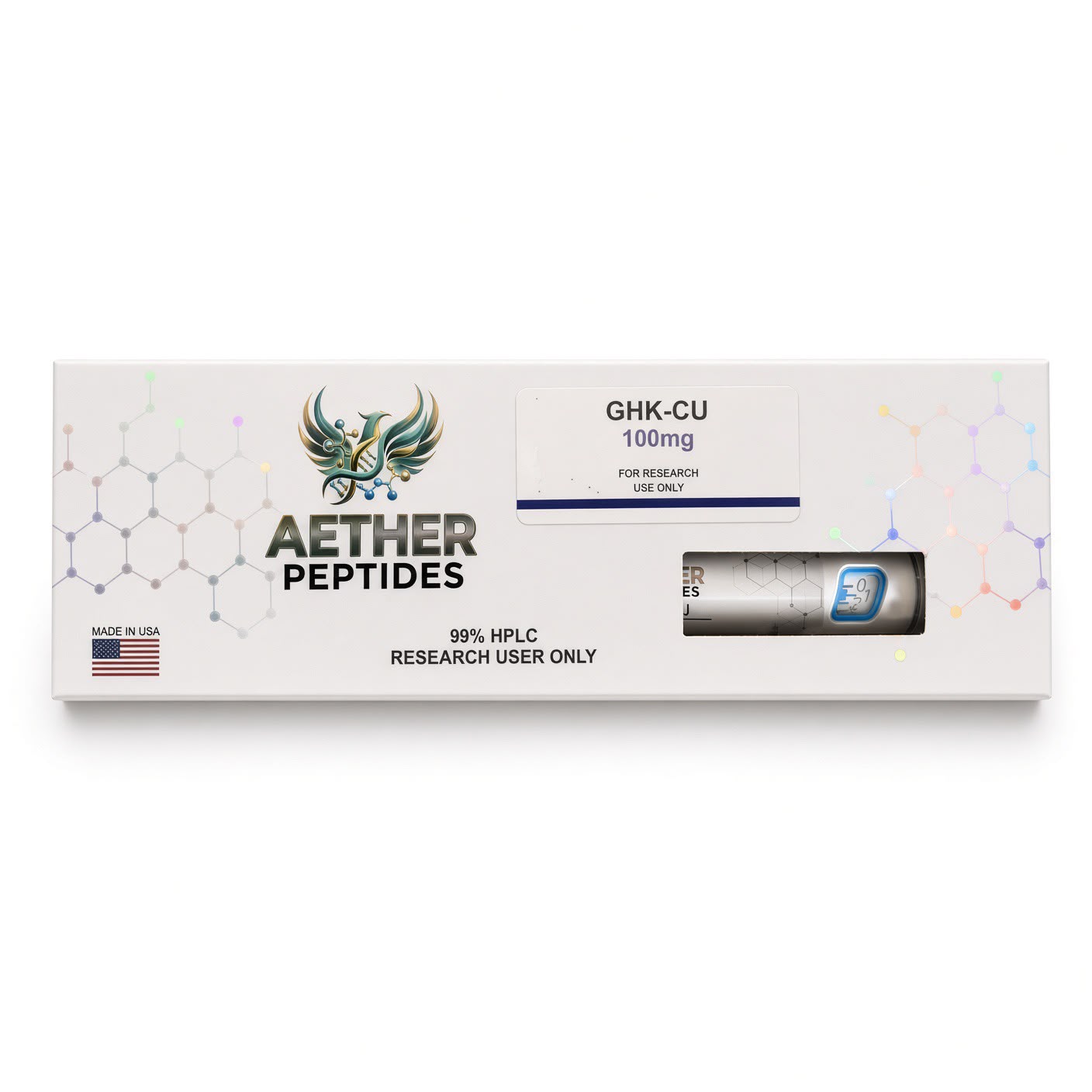
GHK-Cu 100mg

GHK-Cu 100mg

GHK-Cu 100 mg — Copper Tripeptide

GHK-Cu (Copper Tripeptide-1) is a copper-bound tripeptide composed of glycyl-L-histidyl-L-lysine (GHK) coordinated with Cu²⁺. With a molecular formula of C₁₄H₂₂CuN₆O₄, molecular weight of 401.91 g/mol, and CAS 89030-95-5, GHK-Cu is widely studied in peptide and regenerative-biology research.

Research has investigated GHK-Cu for its interaction with copper-dependent biological processes, extracellular-matrix remodeling, collagen synthesis, fibroblast activity, angiogenesis, inflammatory signaling and wound-healing pathways. Its primary research interest is the relationship between GHK-Cu and tissue remodeling, particularly in skin and connective-tissue models.

Research specifications: 100 mg | CAS 89030-95-5 | Molecular Weight 401.91 g/mol | Sequence: H-Gly-His-Lys-OH, Cu(II) complex.

For laboratory research use only. Not intended for human or veterinary use, diagnosis, treatment, or consumption.

Research of GHK-Cu

GHK-Cu (Copper Tripeptide-1) is a naturally occurring copper-binding peptide complex composed of the tripeptide glycyl-L-histidyl-L-lysine (GHK) coordinated with copper(II). GHK has been identified in human biological fluids and tissues and has been investigated for its role in tissue remodeling and repair. When complexed with copper, GHK-Cu has been studied for its effects on fibroblast activity, extracellular-matrix production, collagen synthesis, angiogenesis, inflammatory signaling, and wound healing.

Structure of GHK-Cu

GHK-Cu (Copper Tripeptide-1) is a naturally occurring copper-binding peptide complex composed of the tripeptide glycyl-L-histidyl-L-lysine (GHK) coordinated with copper(II). GHK has been identified in human biological fluids and tissues and has been investigated for its role in tissue remodeling and repair. When complexed with copper, GHK-Cu has been studied for its effects on fibroblast activity, extracellular-matrix production, collagen synthesis, angiogenesis, inflammatory signaling, and wound healing.

Mechanism and Action of GHK-Cu

AOD 9604 has mainly been studied in murine models, and significant experiments have involved relatively large amounts of AOD 9604.[5] These experiments reportedly resulted in a 50% reduction in weight following exposure to the research models. However, it is important to note that the fragment appears to lack any other associated action of hGH, such as a potential increase of IGF-1 (insulin-like growth factor-1), insulin resistance, or cell proliferation. Therefore, the compound may not possess the potential muscle-preserving and anabolic action typically associated with growth hormones. Nevertheless, it appears that AOD 9604 may stimulate weight loss through mechanisms similar to hGH, as it may trigger various cellular pathways that might lead to the release of fatty acids from adipose cells. Additionally, researchers have posited that the peptide may affect the activity of lipases, a group of enzymes that prevent the return of fat to adipose tissues.[6] It is worth noting that AOD 9604 does not appear to affect natural hGH production and does not appear to act as a growth hormone secretagogue. Moreover, it does not appear to impact hunger hormone signaling to either increase or decrease appetite. Murine models comparing AOD 9604 and hGH have reported different outcomes in lean and obese cases.[4] In lean murine models, hGH appears to increase lean body mass, whereas AOD 9604 or a placebo did not appear to produce the same action. Hence, researchers have speculated that AOD 9604 may not be effective in increasing the size of muscle cells and contributing to muscle hypertrophy. However, in obese murine models, both hGH and AOD 9604 appear to exert a weight loss potential. The scientists also commented that there was an apparent 40% reduction in adipose tissue in the hGH group compared to 28% with AOD 9604. Therefore, experiments suggest that AOD 9604 may hold reduced potential compared to hGH in stimulating the release of fats from adipose cells.[7] The researchers also posit that “the lipolytic actions of both hGH and AOD 9604 are not mediated directly through the β3-AR although both compounds increase β3-AR expression, which may subsequently contribute to enhanced lipolytic sensitivity.” Growth hormone likely promotes a greater release of fats from adipose cells due to its proposed impact on insulin resistance. By reducing glucose uptake, it may force cells to potentially utilize more fat instead. In contrast, the fragment AOD 9604 does not appear to increase insulin resistance. Additionally, anecdotal data suggests that AOD 9604 may potentially offer some impact, including modest improvements in cholesterol levels and insulin sensitivity, but it is yet to be confirmed by murine models.

GHK-Cu and Obesity

GHK-Cu and Cardiac Disease

GHK-Cu and Joints

Disclaimer: The products mentioned are not intended for human or animal consumption. Research chemicals are intended solely for laboratory experimentation and/or in-vitro testing. Bodily introduction of any sort is strictly prohibited by law. All purchases are limited to licensed researchers and/or qualified professionals. All information shared in this article is for educational purposes only.

References

  1. Ng, F. M., Sun, J., Sharma, L., Libinaka, R., Jiang, W. J., & Gianello, R. (2000). Metabolic studies of a synthetic lipolytic domain (AOD 9604) of human growth hormone. Hormone research, 53(6), 274–278. https://doi.org/10.1159/000053183
  2. Cox, H. D., Smeal, S. J., Hughes, C. M., Cox, J. E., & Eichner, D. (2015). Detection and in vitro metabolism of AOD 9604. Drug testing and analysis, 7(1), 31–38. https://doi.org/10.1002/dta.1715
  3. Ng, F. M., Jiang, W. J., Gianello, R., Pitt, S., & Roupas, P. (2000). Molecular and cellular actions of a structural domain of human growth hormone (AOD9401) on lipid metabolism in Zucker fatty rats. Journal of molecular endocrinology, 25(3), 287-298.
  4. Heffernan, M. A., Thorburn, A. W., Fam, B., Summers, R., Conway-Campbell, B., Waters, M. J., & Ng, F. M. (2001). Increase of fat oxidation and weight loss in obese mice caused by chronic treatment with human growth hormone or a modified C-terminal fragment. International journal of obesity and related metabolic disorders : journal of the International Association for the Study of Obesity, 25(10), 1442–1449. https://doi.org/10.1038/sj.ijo.0801740
  5. Ng, F. M., Sun, J., Sharma, L., Libinaka, R., Jiang, W. J., & Gianello, R. (2000). Metabolic studies of a synthetic lipolytic domain (AOD9604) of human growth hormone. Hormone research, 53(6), 274–278. https://doi.org/10.1159/000053183
  6. Kopchick, J. J., Berryman, D. E., Puri, V., Lee, K. Y., & Jorgensen, J. O. (2020). The effects of growth hormone on adipose tissue: old observations, new mechanisms. Nature Reviews Endocrinology, 16(3), 135-146.
  7. Heffernan, M., Summers, R. J., Thorburn, A., Ogru, E., Gianello, R., Jiang, W. J., & Ng, F. M. (2001). The Effects of Human GH and Its Lipolytic Fragment (AOD9604) on Lipid Metabolism Following Chronic Treatment in Obese Mice andβ 3-AR Knock-Out Mice. Endocrinology, 142(12), 5182-5189.
  8. Bray, G. A., & Greenway, F. L. (2007). Pharmacological treatment of the overweight patient. Pharmacological reviews, 59(2), 151–184. https://doi.org/10.1124/pr.59.2.2
  9. Heffernan, M., Summers, R. J., Thorburn, A., Ogru, E., Gianello, R., Jiang, W. J., & Ng, F. M. (2001). The effects of human GH and its lipolytic fragment (AOD 9604) on lipid metabolism following chronic treatment in obese mice and beta(3)-AR knock-out mice. Endocrinology, 142(12), 5182–5189. https://doi.org/10.1210/endo.142.12.8522
  10. Kwon, D. R., & Park, G. Y. (2015). Effect of Intra-articular Injection of AOD 9604 with or without Hyaluronic Acid in Rabbit Osteoarthritis Model. Annals of clinical and laboratory science, 45(4), 426–432.