
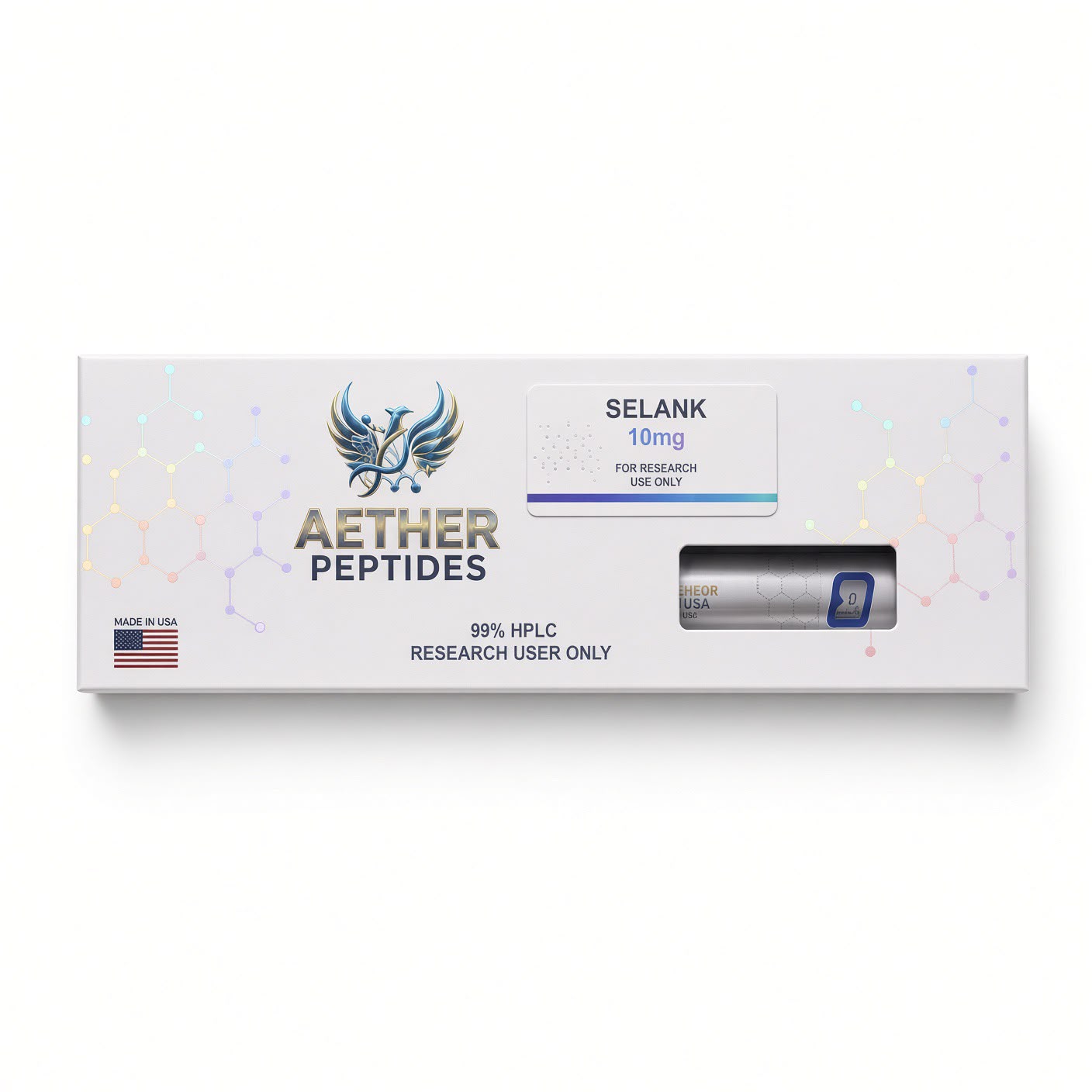
Selank 10mg

Selank 10mg

Selank 10mg — Research Peptide

Selank 10mg is a synthetic heptapeptide derived from the ACTH(4–7) sequence and consisting of Met-Glu-His-Phe-Pro-Gly-Pro (MEHFPGP). It has a molecular formula of C₃₇H₅₁N₉O₁₀S, molecular weight of approximately 813.9 g/mol, and CAS number 80714-61-0.

Semax has been extensively investigated in neuroscience research, including studies of neuroprotection, neuronal signaling, cognitive processes, cerebral ischemia, inflammatory responses and neurotrophic pathways. Research suggests that its biological activity may involve modulation of gene expression, neuroprotective signaling, inflammatory pathways and interactions with regulatory peptide systems.

The compound is structurally related to the ACTH(4–7) peptide region and is commonly studied alongside other regulatory neuropeptides such as Selank.

Research specifications: 10 mg | CAS 80714-61-0 | Molecular Weight 813.9 g/mol | Molecular Formula C₃₇H₅₁N₉O₁₀S | Sequence: MEHFPGP.

For laboratory research use only. Not intended for human or veterinary use, diagnosis, treatment, or consumption.

Research of Selank 10mg

Semax is a synthetic heptapeptide derived from the biologically active ACTH(4–7) region and modified by addition of the Pro-Gly-Pro sequence. Semax has been extensively investigated in experimental neuroscience, particularly for its potential neuroprotective, neurotrophic, cognitive and anti-inflammatory effects. Research has examined its influence on neuronal signaling, gene expression, oxidative stress and inflammatory responses following neurological injury. Unlike conventional small-molecule nootropics, Semax is a peptide-based research compound whose biological activity appears to involve several interacting pathways rather than a single established receptor target.

Structure of Selank 10mg

Semax is a synthetic heptapeptide derived from the biologically active ACTH(4–7) region and modified by addition of the Pro-Gly-Pro sequence. Semax has been extensively investigated in experimental neuroscience, particularly for its potential neuroprotective, neurotrophic, cognitive and anti-inflammatory effects. Research has examined its influence on neuronal signaling, gene expression, oxidative stress and inflammatory responses following neurological injury. Unlike conventional small-molecule nootropics, Semax is a peptide-based research compound whose biological activity appears to involve several interacting pathways rather than a single established receptor target.

Mechanism and Action of Selank 10mg

The precise mechanism of Selank 10mg is not completely established. Research suggests several potentially relevant mechanisms in: Neuroprotective signaling, Neurotrophic pathways, Gene-expression modulation, Inflammatory signaling, Enkephalinase interaction, Metal-binding properties, and Simplified mechanism.

Selank 10mg and Obesity

Selank 10mg and Cardiac Disease

Selank 10mg and Joints

Disclaimer: The products mentioned are not intended for human or animal consumption. Research chemicals are intended solely for laboratory experimentation and/or in-vitro testing. Bodily introduction of any sort is strictly prohibited by law. All purchases are limited to licensed researchers and/or qualified professionals. All information shared in this article is for educational purposes only.

References

  1. Ng, F. M., Sun, J., Sharma, L., Libinaka, R., Jiang, W. J., & Gianello, R. (2000). Metabolic studies of a synthetic lipolytic domain (AOD 9604) of human growth hormone. Hormone research, 53(6), 274–278. https://doi.org/10.1159/000053183
  2. Cox, H. D., Smeal, S. J., Hughes, C. M., Cox, J. E., & Eichner, D. (2015). Detection and in vitro metabolism of AOD 9604. Drug testing and analysis, 7(1), 31–38. https://doi.org/10.1002/dta.1715
  3. Ng, F. M., Jiang, W. J., Gianello, R., Pitt, S., & Roupas, P. (2000). Molecular and cellular actions of a structural domain of human growth hormone (AOD9401) on lipid metabolism in Zucker fatty rats. Journal of molecular endocrinology, 25(3), 287-298.
  4. Heffernan, M. A., Thorburn, A. W., Fam, B., Summers, R., Conway-Campbell, B., Waters, M. J., & Ng, F. M. (2001). Increase of fat oxidation and weight loss in obese mice caused by chronic treatment with human growth hormone or a modified C-terminal fragment. International journal of obesity and related metabolic disorders : journal of the International Association for the Study of Obesity, 25(10), 1442–1449. https://doi.org/10.1038/sj.ijo.0801740
  5. Ng, F. M., Sun, J., Sharma, L., Libinaka, R., Jiang, W. J., & Gianello, R. (2000). Metabolic studies of a synthetic lipolytic domain (AOD9604) of human growth hormone. Hormone research, 53(6), 274–278. https://doi.org/10.1159/000053183
  6. Kopchick, J. J., Berryman, D. E., Puri, V., Lee, K. Y., & Jorgensen, J. O. (2020). The effects of growth hormone on adipose tissue: old observations, new mechanisms. Nature Reviews Endocrinology, 16(3), 135-146.
  7. Heffernan, M., Summers, R. J., Thorburn, A., Ogru, E., Gianello, R., Jiang, W. J., & Ng, F. M. (2001). The Effects of Human GH and Its Lipolytic Fragment (AOD9604) on Lipid Metabolism Following Chronic Treatment in Obese Mice andβ 3-AR Knock-Out Mice. Endocrinology, 142(12), 5182-5189.
  8. Bray, G. A., & Greenway, F. L. (2007). Pharmacological treatment of the overweight patient. Pharmacological reviews, 59(2), 151–184. https://doi.org/10.1124/pr.59.2.2
  9. Heffernan, M., Summers, R. J., Thorburn, A., Ogru, E., Gianello, R., Jiang, W. J., & Ng, F. M. (2001). The effects of human GH and its lipolytic fragment (AOD 9604) on lipid metabolism following chronic treatment in obese mice and beta(3)-AR knock-out mice. Endocrinology, 142(12), 5182–5189. https://doi.org/10.1210/endo.142.12.8522
  10. Kwon, D. R., & Park, G. Y. (2015). Effect of Intra-articular Injection of AOD 9604 with or without Hyaluronic Acid in Rabbit Osteoarthritis Model. Annals of clinical and laboratory science, 45(4), 426–432.